Bollywood brings a standard structure to most of its movies. Romance with dancing, comedy and a problem. Swades has all of this, but it's problem tackles a question that many Indians outside of India, myself included, may think of: "Can I call India home?" Directed by Ashutosh Gowarike, Swades answers this question with all the colors and music that a Bollywood movie should have.
Swades follows Mohan Bhargava (Shah Rukh Khan), a young up and coming NRI (Non-returning Indian) working for NASA as he returns to India to bring back his old nanny Kaveri Amma. Mohan has not returned to India for the past 12 years, thus the title of NRI.
Mohan's trip starts with him at a bookstore and shows him meeting with a girl who presumably recognizes who he is and gives him the wrong directions to Kaveri Amma's house. When he reaches the villiage (in his giant RV, which really entertains the villiage people) he finds that the girl, Geeta (Gayatri Joshi) is indeed an old friend from his time as a child with Kaveri Amma. From that time onwards, a sort of challenge ensues between Geeta and Mohan over Kaveri Amma. However, Mohan falls in love with Geeta and he attempts to win her over as the movie progresses.
Mohan finds himself beginning to like living in India and postpones his return to the States. He sees not only the good parts but also the bad parts of the society set up in the villiage. He actively works to increase the enrollment in Geeta's school, and also uses his skills as a rocket scientist to create a hydroelectric plant to power the entire villiage. The movie shows that no matter how long you stay away, you will always love and embrace your roots. In the end, I enjoyed this movie very much, and somehow did not even notice the length when I first saw it. For NRIs and open-minded non-Indians, this movie is highly recommended.
For many years Bollywood has been found to be the highest producing film industry in the world.However, many of their movies are straight remakes of Hollywood movies, allowing the movie to be produced much faster.Usually these remade movies pale in comparison to the original Hollywood version, but some do incredibly well minus their blatant copying.Many of these films are just there to entertain for the moment without leaving much impact.However, every now and then movies such as these will be a great success, and people will look past the fact that the movie was also made somewhere else. The Bollywood film Ghajini, which is based upon Christopher Nolan’s Memento is a good example of this. In some sense, this remaking of movies will be seen as the globalization of film and ideas. I will be using these two movies to compare and contrast the styles of film that come out of each country’s respective film industry, and asses the globalization of film.
Much more colorful than Memento
Memento is a film directed by Christopher Nolan released in the year 2000. The film follows a man with anterograde amnesia, or short term memory loss, as he attempts to find the man who killed and raped his wife. By keeping notes and taking pictures, Leonard Shelby keeps track of what he’s done and where he has been in his search. He keeps a list of facts in order to make sure the man he is trying to get is actually the right man. The movie flows in reverse chronological order with scenes put in that run in chronological order. This has the effect of forcing the audience to make sure they remember what happened in the earlier scene. As stated by Roger Ebert, “Essentially, Leonard is adrift in time and experience, and therefore so are we (Ebert).” Ghajini is a 2008 film directed by A. R. Murugadoss which was released in India.The film is based on Nolan’s Memento but has many stereotypical Bollywood styles within it. Ghajini is currently the highest grossing Hindi film in history. The movie also follows a patient, Sanjay Singhania, who suffers from anterograde amnesia much like the patient in Memento. “It's a fascinating premise for a movie[Ghajini], and a few years ago, ‘Memento', made by Christopher Nolan, gave us a unique hero who suffers from short haul amnesia, while he searches for his beloved's killer (Gupta).” However, the movie flows in chronological order and has scenes in it that would only be found in a Bollywood movie.
Tattoos look very similar to those found in Memento
http://www.youtube.com/watch?v=0vS0E9bBSL0
Memento is a very dark film that chronicles various violent acts such as rape and murder.The movie uses various techniques to keep the audience interested in the story. Ghajini on the other hand takes cues from Memento but is very heavily influenced by Bollywood styles. There are two scenes that show Sanjay’s past and are very entertaining to watch, and seem to stick more to the stereotypical Bollywood style of film. Two people meet, fall in love, choose to get married but then cannot because, in this case, one of them dies. These romantically styled scenes are not seen in Memento and are what I find to be the stereotype in Bollywood cinema. The movie is “Too long, at three hours and some. Too violent (Gupta).”In addition to this, as seen in many Indian films, there is a clear villain, which was unseen in Memento. In Ghajinithe villain is a man named Ghajini that has killed Sanjay’s wife-to-be. Anupama Chopra says it the best: “he likes to smash iron rods into human heads and forces young girls into both prostitution and organ trade (Chopra).”Many Indian movies, such as the Tamil version of Ghajini and many other Tamil films, are full to the brim with the most stylized violence in current films around the world, a quality unseen in films to come out of Hollywood. To add to the differences that seem to run with Indian culture, Sanjay’s wife was not raped as Leonard’s was in Memento. It almost seems as though rape is still an untouched topic when it comes to movies that are as popular in mainstream Indian culture such as this one.
On the other hand, Memento has some parts that are can be attributed to coming out of an American industry. There is a lot of blood, but unlike Ghajini the violence has not been stylized and is shown as it is. Additionally, the movie shows the basic greed that many Americans face. Everyone in the movie wants something, the police office “Teddy” wants a way to kill certain troublesome criminals, Natalie uses Leonard for her own reasons based on the fact that Leonard will not remember later. And Leonard himself allows himself to forget what he has done so that he can continue to live as he does, continuously avenging his wife’s death.
In terms of globalization, nothing is displays it more than the name of India’s film industry. Bollywood is a play off of Hollywood’s name, except they use a “B” as the first letter to signify that it is based out of Bombay (Mumbai). Many movies coming out of Bollywood can be seen as remakes of famous Hollywood movies, displaying the globalization of American film. The main way these two movies display the globalization in film is just how their main plot concept is the same thing. Amir Khan stated that the director for Ghajini wrote the script for the movie after hearing about Memento but not watching it. However, to me, this seems debatable because the tattoos used on Sanjay’s body in Ghajini seem very similar to those seen in Memento, and it is highly unlikely that these similarities are just coincidental. The idea for this story started with Jonathan Nolan’s short story Memento Mori and became a movie directed by his brother Christopher Nolan and went on to the Indian film industry to become Ghajini directed by A R Murgadoss in both a Tamil version and a Hindi version. This shows how one little idea has become a huge movie in one country, and the highest grossing movie in another.
Although Memento and Ghajini take a similar plot, the styles are extremely different. Memento capitalizes on the American love for suspense and thrillers whereas Ghajini sticks to basic themes that have shown that they are what Indians love the most. Each movie takes a similar topic and bends it to the style of cinema that the people in the film’s respective country would enjoy. Memento has violence, but sparingly and it more or less sticks to assessing the psychological areas on the topic of short term memory loss. Ironically enough, Ghajini starts with a team of doctors that wish to assess Sanjay’s pysch but the movie moves onto becoming a violence and romance filled story for the masses. Even with these differences, the similarities can still be seen, and the effects of globalization can still be felt when watching the two movies one after the other.
Works Cited
Chopra, A. (2009). Ghajini. Retrieved from NDTV Movies: http://movies.ndtv.com/reviews.asp?lang=hindi&id=368
Ebert, R. (2001, april 13). Memento. Retrieved from rogerebert.com: http://rogerebert.suntimes.com/apps/pbcs.dll/article?AID=/20010413/REVIEWS/104130303/1023
Gupta, S. (2008, December 25). Ghajini (Movie Review). Retrieved from expressindia: http://www.expressindia.com/latest-news/Ghajini-Movie-Review/402773/
Whirled Cinema
In the world of music, television, news, and other popular media, there is perhaps no place more widely used to portray the many views and perspectives of the world than in the realm of cinematic entertainment. Across the globe, filmmakers have attempted to alter, celebrate, and recreate real life on the big screen. These artists have the power to bring many tabooed or unrealized subjects to the eyes of viewers worldwide; and when this happens, we have begun to understand the term “World Cinema.” As Americans, we tend to absorb large amounts of propaganda in the media, without even realizing how it may alter and close our minds. In an attempt to escape the endless cycle of ignorance and close-mindedness that plagues us, many have turned to the writings, beliefs, studies, and films of foreign countries, analyzing and comparing the similarities and differences among the various types in a search for greater truth. Here, I will compare the Danis Tanovic film No Man’s Land, to Turtles Can Fly, written and directed by Bahman Ghobadi. I will discuss how the two films portray global warfare, and its affects on the nations it tears apart. I will also address the different views of world powers, such as the United States and the UN.
Danis Tanovic’s film, No Man’s Land, is a film that focuses on the Bosnia-Herzegovinian conflict, its global implications, the interference of the UN, and the triviality of war itself. The story begins with a relief squad that gets lost in a deep fog. When the sun rises, they are decimated by enemy guns, leaving only two survivors in a mine filled trench. When the enemy soldiers are sent to inspect the trench, a scuffle leaves two enemy soldiers in a face off, while one lays helpless, immobile on an active mine. The events of the film expose the horrors of war, as well as the tragedy that ensues when neutral forces interfere.
Turtles Can Fly, is an Iranian film that focuses on similar concepts of war. However, it is played out through the eyes and shattered lives of the forgotten Iranian children who find refuge in the hills of its borders, fighting desperately to survive the violent conflict that surrounds them. The main character is a thirteen year old boy named Satellite who leads the young orphans living near the Turkey-Iran border. They pick mines from the neighboring fields for payment, while Satellite installs satellites for the people who eagerly await the news and updates leading up to the fall of Saddam Hussein.
First, an uninformed reader should know that the trademark throughout Ghobadi’s films is the prevalence of the war theme. In his previous films, A Time for Drunken Horses and Marooned in Iraq, acclaimed writer/director focuses on plight of his people, caused by the endless wars that have ravaged the land and devastated its people. In Turtles Can Fly, he continues on this track, using the film’s relatively large number of orphaned children to bring light to Iran’s situation. New York Times reviewer A.O. Scott captures the film’s purpose in a sentence: “The film is less concerned with politics, though, than with the struggles of daily life, particularly those of the local children, many of them orphans and refugees, some of them maimed by mines and otherwise scarred by war.” (“Depicting Kurds' Misery with Tough Lyricism.” NY Times.18 Feb. 2005) Indeed, Ghobadi portrays the pain felt by the refugees through the eyes of the gentlest, most innocent victims of war. The children that comprise the greater majority of the film’s cast, however, are not merely symbols of the Iranian struggle, but of strength. The harsh conditions that have mentally and physically damaged the young kids who continue to fight for survival are also the trials which serve to fortify the wills of those that overcome:
The hardships these children have faced are horrifying, and Mr. Ghobadi neither sweetens nor sensationalizes them, which makes "Turtles Can Fly" all the more painful to watch. It is a heartbreaking film, and cruelty sometimes seems to be not only its subject but its method. Like the child on a high cliff that is one of its recurring images, the film walks up to the edge of hopelessness and pauses there, waiting to see what happens next.
(A.O. Scott. NY Times.18 Feb. 2005)
In this film, Ghobadi depicts the pain and suffering of children in order to show the everyday lives of people who are affected by war. The loss of family, friends, and even limbs is brought to life on the big screen. This film festival hit opens the eyes of all its viewers to the harsh reality that those forgotten refugees and orphans are exposed to each day.
Ghobadi also uses mise-en-scene on numerous occasions to emphasize certain themes. At the start of the movie, we see a young boy, Satellite, installing the all important dishes that connect the refugees to the outside world, giving them vital information about the progress of the war. As the film progresses, one can see how the people watch and wait anxiously as the fall of Saddam looms on the horizon. Their hopes rest upon the shoulders of the U.S. army whose presence becomes increasingly evident. However, at the end of the film, the viewer is left to watch as the soldiers come marching through the town with tanks and guns, and how Satellite, who was among the most supportive of their presence, turns away from them as rain falls with his face to the ground, seeming as if he has lost all hope and faith that their success will actually save the village. This parallels the views of Ghobadi’s people, as they were let down by the country who first saved, then forgot them; leaving them in limbo as their “saviors” pursued other goals, adding the conflict rather than ending it.
Danis Tanovic’s film, No Man’s Land, continues to open ignorant eyes to the atrocities of war, something he knows well after spending two years on the front lines of Sarajevo, filming for the Bosnian Army. In this film, the viewer is also subject to the vision of pain and death caused by the ceaseless war in Bosnia. Tanovic brings the scope of the violent war to a smaller scale, with one soldier representing each side. Ciki, the Bosnian soldier, and Nino, the Serb argue viciously about who initiated the violence,while the booby trapped Bosnian, Cera, lies motionless lest he detonate the mine on which he impatiently lies. As the soldiers begin to tell stories and become acquainted, as well as work together to keep the mine from detonating,the viewer can clearly see the similarities between both sides (especially after the two bickering soldiers realize they have dated the same woman). Tanovic uses the scene of the two enemies-turned-friends to convey the fact that it is possible to set differences aside and talk through disagreements, but as this is seldom the road taken in life, it is not the resolution to this film. For when the soldiers become hostile again, they each aim guns at each other, with gun barrels just feed above Cera, who tells them both to “cut it out.” The camera view is from the ground, emphasizing the barrels of the angry men, ready to fire, as well as the exhausted victim of war who has had enough. Tanovic implies that the war is futile. It solves nothing, yet causes countless deaths; not only affecting the men willing to die for their nations, but destroying the lives of all who get caught in the crossfire.
Throughout the film, the presence of the UN serves to bring to light the power’s neutrality in the face of war and death. They are a force neither army wishes to provoke, yet they lack the will or humanity to do any good with their position. Instead, the UN is portrayed as a meddlesome nation, capable only of unwanted interference and of adding further complication to the fray. When a UN tank arrives on the scene, camera angles once again help to convey the intrusive, powerful aura that becomes them. The camera provides a close up of the white tank’s big, blue lettering, as the letters, U.N., fill the screen. The tank pulls up over the edge of the trench with a sharp halt, seeming to show the UN’s intrusive, arrogant, and almost ominous nature.
When an ambitious reporter teams up with a UN soldier who is tired of doing nothing in the face of the chaos that surrounds him, they attempt to force the UN into action. However, the results of their endeavor suffice only to drive Tanovic’s point home: “humanity is the tragic victim of war.” (Travers, Peter. Rolling Stone. 6 Dec. 2001). As a UN mine expert comes, the hopes of the soldiers grow, but tragedy is the end result. In a violent conflict, the two soldiers kill each other on national television, the reporters concerned only whether or not the action was captured on camera, while Cera is left alone, still trapped, waiting for aid that will never come.
Writers and directors such a Ghobadi and Tanovic are popping up in various cinemas worldwide. Their aim is to bring much needed attention to the unseen suffering of warring nations. Armed with camera crews, microphones, and willing actors, they attempt to recreate the savage reality that goes unnoticed by the world. As they use their life experiences and those of their people to create heart wrenching, eye opening films, they simultaneously bridge the gap between the haves and the have-nots. Rather than enlisting and becoming part of the violence this is how they fight to end the whirling, perpetual darkness of war.
Works Cited
"Danis Tanovic." IMDB. 11 Mar. 2009 .
·Scott, A.O. "Depicting Kurds' Misery with Tough Lyricism." New York Times 18 Feb. 2005. .
Travers, Peter. "No Man's Land: Review." Rolling Stone 6 Dec. 2001. .
The Holocaust was a pivotal time in the history of the world leaving no corner of the globe unaffected.Some nations’ Jewish population was subjected to torture and genocide at the hands of Adolf Hitler and the German Nazi Party.Others fought hard to put an end to Hitler’s regime in World War II.Because the Holocaust had such a widespread effect, many films have been made documenting or addressing this time in history.Two of these films are the American The Boy in the Striped Pyjamas released in 2008 and the Italian Life is Beautiful (La Vita é Bella) released in 1998.The Boy in the Striped Pyjamas is a film depicting the Holocaust experiences of the Nazi Germans, while Life is Beautiful depicts an Italian Jew’s experiences.Both movies do have something incredibly important in common.That is the lost innocence of a child.In Life is Beautiful Guido must protect Joshua from being killed in a Nazi concentration camp and shows how the Holocaust affects Giosue’s life.In The Boy in the Striped Pyjamas we are introduced to Bruno, whose father is a Nazi officer.The movie depicts how Bruno discovers and copes with what is really going on in the Holocaust.In my argument, I contest that both Life is Beautiful and The Boy in the Striped Pyjamas share a global style of Holocaust movies; the nations’ drastically different experiences during the Holocaust shine through their film productions.
Both films have many similarities; however, they have vastly more differences.Both films begin with an idealized version of the nation that the film is set in.Life is Beautiful begins on a lush Italian countryside and moves to the city where everything seems to go as Guido, the protagonist, expects.The Boy in the Striped Pyjamas also begins in an idealized Berlin, Germany under Nazi control.Both movies contain high-key lighting and cities bustling with people.As the plot thickens in both movies, the lighting scheme changes from high-key to low-key.In Life is Beautiful, the bright Italian city gives way to a dim concentration camp.The camp barracks especially are dimly lit with just a bright doorway providing light.The idealized Berlin of the Boy in the Striped Pyjamas becomes a home in the countryside decorated almost entirely in shades of gray and dimly lit only by light through small windows. This is contrasted with the brightly colored woods where Bruno plays and his imagination runs wild, free from the censorship of his parents.
The roles that the fathers play in the films share some similarities as well.Guido of Life is Beautiful is a loving father “who dares to find humor and tenderness in the midst of the Holocaust” and must lie to his son, Giosue, about what is really going on in the concentration camp (Maslin).He makes up an elaborate story about the Holocaust being a game in which you earn points by not complaining, and first prize is a tank.Bruno’s father in The Boy in the Striped Pyjamas must also lie to his son about the realities of his work as a Nazi officer.He encourages Bruno to continue believing that the Jews in the concentration camp are farmers on a farm.Although their motives are different, they both try to protect their sons’ innocence by hiding the truth from them.
The two fathers are drastically different in their character, however.Bruno’s father can be a cold man more concerned with is work than his family.He tends to be a “Because I said so” kind of father who keeps himself separate from his son as the authority in the family.Guido is very different in that he encourages Giosue’s imagination and creates all kinds of elaborate stories to share with his son.He is warm and personable rather than cold and standoffish.“In some ways Guido has more obviously in common with the Little Tramp, Don Quixote, or even Christ” (Haskins 377).Guido is his son’s hero and really takes the time to get to know his son in ways that Bruno’s father doesn’t.In the end, Guido sacrifices his life for Giosue, whereas Bruno dies partially due to the lack of vigilance of his father.
Another character similarity is in the two children in the movies.Both Giosue and Bruno are fueled by larger than life imaginations.Bruno is able to believe that the concentration camp is no more than a farm and Giosue is able to be convinced that the Holocaust is no more than an elaborate game.They both are also looking for companionship.Giosue’s father, Guido, is his best friend and companion throughout the movie.Bruno befriends a Jewish boy named Shmuel who he follows out of loyalty “into a gas chamber where naked men and children huddle, and [their] hands clasp before the film cuts to black” (Dargis).They both must grow and lose their naivety because of the Holocaust.Both films use young and impressionable children to emphasize the impact of an event such as the Holocaust.It exposes the children to hardship and death that no child should be exposed to at such a young age.This approach allows the viewer to see how truly horrible this was.
The experience of each nation during the Holocaust had a big impact on the creation of these films.The American film, The Boy in the striped Pyjamas, depicts the Holocaust as “trivialized, glossed over, kitsched up, and commercially exploited” (Dargis).It really doesn’t address the true issues of the Holocaust.This is most likely because the people of the United States were safe in their homes in North America while European Jews were shipped off to these camps.The movie does not even address any of the hardships facing the Jewish community.Instead, the movie focuses of the hardships of a Nazi family.Those with any ties to the Holocaust whatsoever understand that the plight of the Jews dwarfs any hardship endured by the Nazis.To turn a blind eye to this and make a film sympathetic to the Nazis is exploiting the situation for a seemingly heart-wrenching plot about an innocent small boy who becomes a casualty of war. Although the viewer feels bad for Bruno, what about Schmuel?He was taken away from his family and lost everything.He had been living in the camp while Bruno had been living lavishly.He is the true victim.
Life is Beautiful, on the other hand, allows you to fully sympathize with the Jewish experience of the Holocaust.The viewer is introduced to Guido, a man who through the first half of the movie works hard to win over his woman, open his own bookshop, and start a family only to have it torn apart by the Nazis.When in the Nazi camp, Guido’s spirit remains unbroken.He spends his entire time there protecting his son from danger and even giving his son rations of his own food.His time there ends as most people’s did, in death, but through his death, Guido saves his son and wins over the viewer.It is the fact that Italian Jews really went through this hardship that makes this movie much more believable and a much more relevant movie than The Boy in the Striped Pyjamas.The movie is able to draw on pre and post war Italian history to create the perfect setting to tell this story of self sacrifice and love for one’s family no matter the circumstances.Although Guido lost all the material possessions he had worked so hard for, he never lost his spirit, and never lost his family.
Both Life is Beautiful and The Boy in the Striped Pyjamas attempt to tell a similar story from opposite sides.The Boy in the Striped Pyjamas tells of the hardship of Nazi families struggling with the atrocities being committed by their fatherland.Life is Beautiful tells of the hardship faced by Italian Jews during the Holocaust.In the end, the Italian film is able be much more affective because the Italian people really did experience this, and it is a subject that is close to many Italians’ hearts.Many Italians have relatives who died in or lived through the Holocaust, and it is important to them that the injustice done to them and their bravery in the face of this injustice live on in history.The American film is much less affective because in history, the Nazi’s hardships are of incredibly lesser magnitude than the Jews.The American people did not have to experience the Holocaust the way Europeans did.This prevents total understanding and a complete ability to tell the story the way the Italians can.By analyzing these two movies, it is clear that in order for a nation to understand the Holocaust, the nation had to have experienced it.
When one goes to see a movie, often times they go to be entertained. As movies became more and more common though, people started to make movies into a form of art. As with any form of art, things are not ever set in stone. There are no rules, only things that people tend to agree on. Therefore, in the case of Electroma and The Death of Mr. Lazarescu, one should be able to accept some oddities in the filming, right? However, to those who lack an artistic eye, these movies can be agonizing, and trying on the patience of the viewer. Both of these movies tend to have long scenes with no dialogue, or a slow progression of the story. What is the purpose of this silence? Why do these movies take so long to do something new or interesting?
It turns out that these movies, when compared, are very similar. The plot for both is simple. In Electroma, two robots go on a quest to become human in a very emotional story. The Death of Mr. Lazarescu is about an old, diseased alcoholic who starts feeling sick, until he is sent to several different hospitals. In the case of Mr. Lazarescu, the story is paired with several substories that detract from the main event. Lots of people tend to be bothered by this, since it detracts from the main story and is distracting. However, these insights into other people's lives help give the movie a deeper appeal and helps bring us closer to the characters. In the case of Electroma, the two robots have long, extended shots of them walking, and that's it. The camera will not pan or dolly, and the shot will stay as a long shot. Some of these motionless “boring” shots are more than a minute in length! To those not able to sit and wait, or those who are unable to see the underlying significance, these shots will kill the movie. Well, that seems to make no sense. Why would the artists continue to do something that seems to push their audience away? I believe the answer to that question is simple: they're artists. An artist normally expresses themselves through some kind of medium. In these cases, that medium is film.
So what is the artist trying to do by torturing us into watching incredibly long shots of nothing going on? Some of the effects of making us watch these seeming pointless scenes are actually subconscious. If one makes the attempt to watch the movie without complaining and with an open and accepting mind, one will notice a growing connection with the characters in the movie. Suddenly, a scene of the person walking to their fridge to get a drink becomes a portrait of depression, habit, and futility. A scene of two robots staring at each other becomes an interpretation of hope and inspiration. When the director makes a shot of nothing happening with the main characters, that's because he or she doesn't want you to focus on the main characters. In that shot, there's something greater happening that one has to find. By observing symbolism and transliteration, one can literally morph the shot into a new one. Other times, however, the director extends the shots to help show a passage of time. All too often, we are used to the manipulation of the passing of time through modern cinematography. When this luxury is taken away, however, it quickly becomes apparent how long it takes some things to actually happen. This is done throughout both movies. In Electroma, the final walking scenes are extended to help the viewer understand exactly how long and how far these robots have been traveling. In Mr. Lazarescu, the lack of time manipulation helps communicate how inefficient the health care system is, and how long it takes things to actually happen. With all these small subtleties, it may be hard to catch them all. That's why most people tend to look at the overall picture (the two robots walking, or the man on the stretcher still sitting there).
There are quite a few reasons that a director would extend a scene like this. It has already been mentioned what the scene says when this happens, or how to look at the scene, but the director has a very clear cut reason for his actions (no pun intended). Some of the critical ways to analyze this characteristic of film are obvious, but the director sometimes wants to show implicit meaning into the film. Using this, the director portrays some kind of ideological meaning. This can come in either the shots or symbolism. In the case of Electroma, there is a scene when the camera leaves the focus of the robots walking through a desert and starts focusing on the structure of the sand dunes. At one point, the sand forms an implied image of a nude woman's body. This is a form of symbolism applied to the scene where the robots are walking. The “body” makes the simile that the sand is the skin of Mother Earth. In Mr. Lazarescu, there is implicit meaning behind the trivial dialogue of the doctors and nurses of the hospitals. The conversations constantly surround the ideas of things outside the hospital, showing that these workers have other important things in their lives that they are focusing on. These things often seem that they are more important than the lives of the patients they are working on. In most well-made movies, there is implicit meaning in a lot of dialogue, scenery, plot, and actors. In those few extremely well-made movies, every little event, item, and place has a special meaning to the story, and helps communicate foreshadowing, true emotions/thoughts, or even the director's opinion on controversial subjects. Another example in Electroma of this implicit meaning comes from the choice of robots and a specific scene in the movie (when the robot-heroes' fake human disguise wears off). The robot-heroes find themselves seemingly naked in front of a large crowd of normal-robots (including law enforcement). This scene takes place in front of a judicial courthouse. Through the characters used in the scene and the location of the scene itself, there is a STRONGLY implied sense of justice, truth, and conviction. At the closing of this scene, the robot-heroes flee from the other robots and try to find a place to hide. However, if one was impatient to sit through the entire scene (because of the lack of events happening), they wouldn't notice the melting ice cream the young robot-boy was holding (relates to the robot-heroes' melting “skin”) and they wouldn't catch the pure shock, drama, and awkwardness only implied through the long silence and literal staring contest between the two teams of robots.
It is possible to discuss the incredible importance behind awkward silences, long shots, little events, and other such seemingly trivial movie characteristics. A movie may seem boring to most due to these traits. However, if seen through the correct mindset, these movies can blow people away with the level of profound meaning and symbolism. In Mr. Lazarescu, there are plenty of times in the movie where one can just stare at Mr. Lazarescu and focus on his pain. By focusing and using sympathy, one feels so much MORE connected to our poor old man, even if he is an alcoholic. Subtleties in film are just that: subtle. However, they are all done on purpose, and must be taken into account. If they are not taken seriously, or ignored (through ignorance or from not being noticed), then the movie loses its meaning, and, consequently, its value.
These shots help show the different kinds of shots that comprise Electroma. They are either long shots with no background activity, or close-ups with no facial expression. Keep in mind that this French movie has no dialogue.
There shots are from The Death of Mr. Lazarescu. Notice how the character is either just sitting or laying there. There is not much going on in terms of the character's actions. This can sometimes be a turn-off, but it's much better to take advantage of the shot and learn more about the character by looking around his house. This helps the viewer grow deeper attached to the character.
Works Cited
"Daft Punk's Electroma Movie Reviews, Pictures - Rotten Tomatoes." ROTTEN TOMATOES: Movies - New Movie Reviews and Previews!. 11 Mar. 2009 .
"Death of Mr. Lazarescu, The (2006): Reviews." Movie Reviews, Music Reviews, TV Show Reviews, Game Reviews, Book Reviews - Metacritic.com. 11 Mar. 2009 .
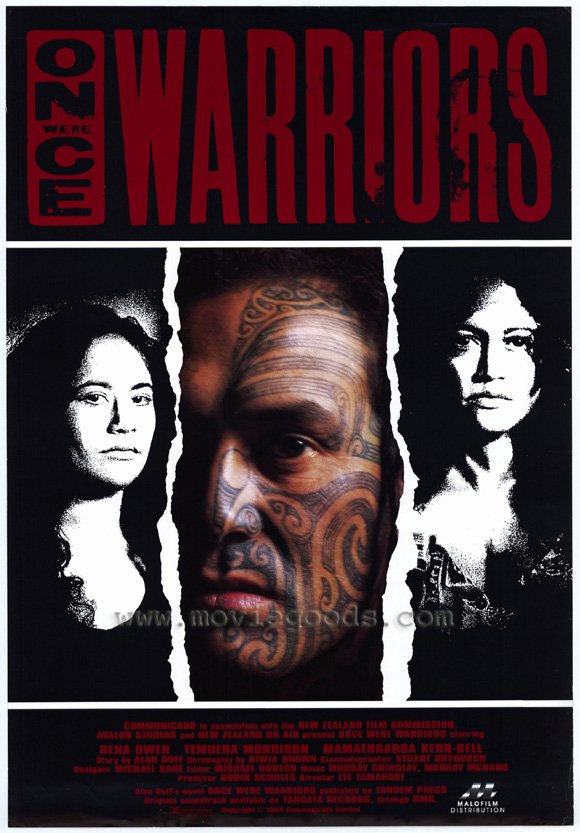
In the wide world of movies, New Zealand is is known for a few things. Mainly, joint productions with the United States or other countries have made their appearance. Using New Zealand's beautiful scenery, films such as Lord of the Rings and The Chronicles of Narnia took to the top and put a spotlight on New Zealand's landscape. However, not all films are just scenic in New Zealand. Once Were Warriors tells a small story about a Maori family living in poverty.
(Spoiler Alert)
Once Were Warriors is a touching and shocking movie about the Maori people in general, but mainly focuses on a family. This family is a typical family plagued by an alcoholic and abusive father with little care about his family, and too much care for his "mates" and partying. This character would rather choose a drink over visiting his son Boogie in a detention center, and it is him who is the ultimate downfall of this family. A good first half of the movie is establishing characters, plot lines, and exposition. In the second half of the film, we learn that one of Jake's (the father's) friends, Bully, rapes Jake's daughter, Grace. This is the fault of Jake, seeing as he was passed out drunk after a party thrown in their own house. The shame, guilt, and pain of Grace is shown when she runs away from home. In the end, she hangs herself after being verbally and physically abused by her father for running away in the first place. The family splits, as Beth (the mother) takes her daughter back to native Maori lands to bury her. The resolution of the story comes when Beth finds Grace's journal entry about her rape, and confronts Jake and Bully. Jake snaps, and finalizes the destruction of the family by beating Boogie to a pulp and telling Beth to leave and never come back.
This movie has strong values in it related to past culture, and also has meaning behind the political/class themes. These Maori people in the city are discriminated against as being "dirty", and this is reflected in their lifestyle. None of the children raised by Beth truly understand their Maori background, and this fact helps communicate the loss of cultural identity and pride. When the son Boogie was thrown into the detention center, he reidentifies with his lost culture and looks towards it for inner strength. This realization on his part makes him re-evaluate his life and his actions. There is much to do with the Maori culture being lost and revived through the main character's actions and values, and much to do with the prejudice against the Maori people as seen by Jake.
As far as more mis-en-scene elements, there were plenty of lighting tools used to help make this film effective. The dark lighting used whenever Jake was drunk or partying was used to subliminally hint that we should be uncomfortable with this, and to help show how dirty and unkempt the house was. In general, the darker lighting corresponded directly with the darker characteristics of Jake. The scene of Grace walking around the city before returning home was a classic type of mis-en-scene, encompassing the use of low-key lighting, long shots, and rain to show seperation, depression, confusion, and ultimately darkness. During those scenes, Grace was contemplating suicide, and was extremely alienated from everyone, including her best friend. This scene was a strong opportunity for the audience to align their emotions with Grace's. The last scene I would like to mention is the burial scene. All the sudden, once Grace dies, brighter and brighter lighting is being used, symbolizing the coming of something good. The natural characteristic of light is to expel darkness, and from the moment these scenes take place, a rebirth of Beth, Boogie, and the other children occurs. Beth gains courage and power to confront her abusive husband about his friend. Grace's homeless best friend gains a new home. The entire family starts learning to love each other again, and everything seems resolved. Even the house is cast in a brighter light. Truly, Grace's funeral symbolizes the beginning of a new era for Beth and her family. The reindentification of the Maori culture into Beth's family gives them strength, pride, and courage. This is a strong subliminal message told through these elements of mis-en-scene.
"No Man's Land" is a skillfully crafted cinematic masterpiece that allows for the viewer to make infinitely many interpretations of the film and who is right and wrong. When three men of opposing sides get caught between the front lines, can they work together to get back to their respective sides or will national rivalries prevent cooperation and tear them apart? The plot thickens further as the UN and media get involved.
'No Man's Land" does a good job of leaving the viewer with questions that are not answered in the film. The biggest question is who is right and who is wrong. There are two warring armies and soldiers from both who argue who started the war and whose side has committed more atrocities. There is a well-meaning UN soldier who is held back by the authorities whose idea of neutrality is to avoid interfering at all. There is a news reporter who is either trying to let the world know about what is going on or trying to use the situation in her own favor to spin a story that will make her famous. All in all, the viewer must take all this in and decide who the true protagonist of the film is.
Surprisingly, the film makes a statement, not about either of the two warring sides, but about the neutral UN and its flaws. It is critical of the UN's lack of involvement in situations where it has the power to help. In this situation, three lives hang in the balance while the commanding officers of the UN discuss what to do and avoid taking action until it is inevitable. The film will keep the viewers on the edges of their seats while watching this not-so-typical war movie where the action is limited, but the suspense is prevalent and exciting.