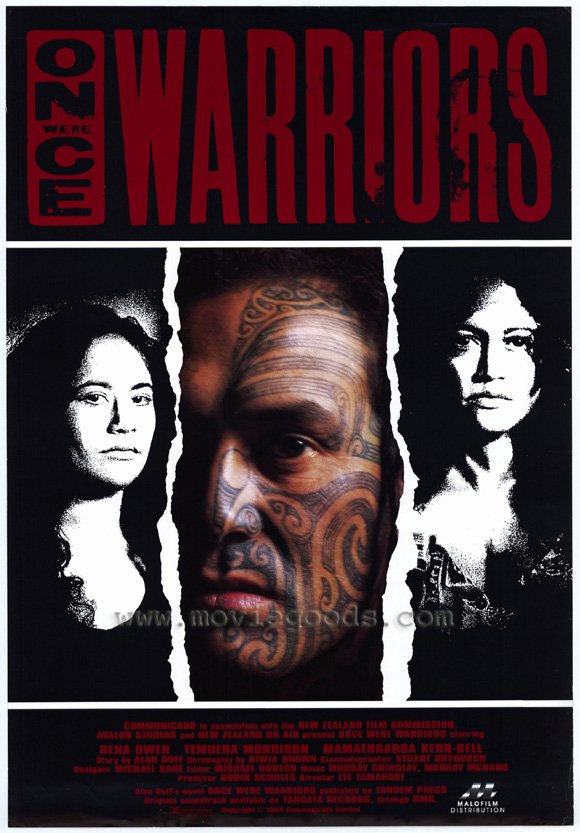
In the wide world of movies, New Zealand is is known for a few things. Mainly, joint productions with the United States or other countries have made their appearance. Using New Zealand's beautiful scenery, films such as Lord of the Rings and The Chronicles of Narnia took to the top and put a spotlight on New Zealand's landscape. However, not all films are just scenic in New Zealand. Once Were Warriors tells a small story about a Maori family living in poverty.
(Spoiler Alert)
Once Were Warriors is a touching and shocking movie about the Maori people in general, but mainly focuses on a family. This family is a typical family plagued by an alcoholic and abusive father with little care about his family, and too much care for his "mates" and partying. This character would rather choose a drink over visiting his son Boogie in a detention center, and it is him who is the ultimate downfall of this family. A good first half of the movie is establishing characters, plot lines, and exposition. In the second half of the film, we learn that one of Jake's (the father's) friends, Bully, rapes Jake's daughter, Grace. This is the fault of Jake, seeing as he was passed out drunk after a party thrown in their own house. The shame, guilt, and pain of Grace is shown when she runs away from home. In the end, she hangs herself after being verbally and physically abused by her father for running away in the first place. The family splits, as Beth (the mother) takes her daughter back to native Maori lands to bury her. The resolution of the story comes when Beth finds Grace's journal entry about her rape, and confronts Jake and Bully. Jake snaps, and finalizes the destruction of the family by beating Boogie to a pulp and telling Beth to leave and never come back.
This movie has strong values in it related to past culture, and also has meaning behind the political/class themes. These Maori people in the city are discriminated against as being "dirty", and this is reflected in their lifestyle. None of the children raised by Beth truly understand their Maori background, and this fact helps communicate the loss of cultural identity and pride. When the son Boogie was thrown into the detention center, he reidentifies with his lost culture and looks towards it for inner strength. This realization on his part makes him re-evaluate his life and his actions. There is much to do with the Maori culture being lost and revived through the main character's actions and values, and much to do with the prejudice against the Maori people as seen by Jake.
As far as more mis-en-scene elements, there were plenty of lighting tools used to help make this film effective. The dark lighting used whenever Jake was drunk or partying was used to subliminally hint that we should be uncomfortable with this, and to help show how dirty and unkempt the house was. In general, the darker lighting corresponded directly with the darker characteristics of Jake. The scene of Grace walking around the city before returning home was a classic type of mis-en-scene, encompassing the use of low-key lighting, long shots, and rain to show seperation, depression, confusion, and ultimately darkness. During those scenes, Grace was contemplating suicide, and was extremely alienated from everyone, including her best friend. This scene was a strong opportunity for the audience to align their emotions with Grace's. The last scene I would like to mention is the burial scene. All the sudden, once Grace dies, brighter and brighter lighting is being used, symbolizing the coming of something good. The natural characteristic of light is to expel darkness, and from the moment these scenes take place, a rebirth of Beth, Boogie, and the other children occurs. Beth gains courage and power to confront her abusive husband about his friend. Grace's homeless best friend gains a new home. The entire family starts learning to love each other again, and everything seems resolved. Even the house is cast in a brighter light. Truly, Grace's funeral symbolizes the beginning of a new era for Beth and her family. The reindentification of the Maori culture into Beth's family gives them strength, pride, and courage. This is a strong subliminal message told through these elements of mis-en-scene.

The picnic scene is another example of the lighting being used to convey a point. They are relating back to their heritage and bringing light into their dark world, thus this scene is markedly brighter than anything seen previously in the film.
ReplyDeleteThe attention to the mise-en-scene truly makes the movie. The use of lighting and shots from a handheld camera truly make the audience feel as though they are in the film not merely viewing it. Very good comments on when different lighing comments were used. This is a very harsh movie that never feels cheesy due to a very good director and cinematographer.
ReplyDeleteYou make the mise-en-scene point very clear. The lighting is a very, very important part of the movie. Whenever Grace goes to her room or to her best friend's car, There is always colorful graffiti or posters hanging up, which is a contrast to the usual dark rooms littered with beer bottles and such. At the actual burial, the people are silhouetted in front of the orange sunset as Grace is lowered to the ground.
ReplyDeleteThe dark lighting, that you mentioned, accented with a deep red light allowed Jake's character to become more monstrous and terrifying. Contrast to that, the scene where the kids are hiding in the bunk bed involved a different use of dark lighting, one in which intensified the fear and turmoil of the situation downstairs.
ReplyDelete